Text4GCN
A Python framework for text classification using Graph Neural Networks.



Text4GCN converts a collection of text documents into a word-document graph and trains a Graph Convolutional Network (GCN) on it for document classification. The graph captures vocabulary co-occurrence patterns that traditional bag-of-words models miss.
Scope and limitations
- Scientific niche: text-graph construction and TGCN with Related Word Filter (RWF) — fewer edges / less memory, accuracy ≈ classic TextGCN (Pereira & de Castro, DCAI 2022). Not a drop-in replacement for fine-tuned transformers on short-text SOTA.
- Transductive learning: test documents are included in the graph at construction time (same as Yao et al., AAAI 2019). New documents require rebuilding the graph and retraining.
- Default protocol: dropout 0.5, lr 0.02, hidden 200, early stopping 10, 10% of train as validation via
TextPipeline.execute(validation_ratio=0.10).
How it works
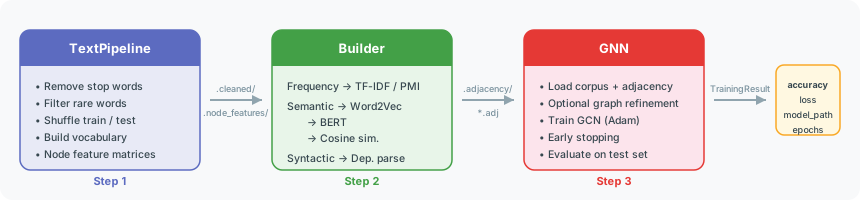
The pipeline has three steps: preprocess text → build the graph → train the GCN. Each step writes files to disk so you can resume at any stage.
Key features
- Three adjacency strategies — frequency (TF-IDF/PMI), semantic (Word2Vec, BERT, cosine similarity), syntactic (dependency parsing, LIWC)
- Graph refinement — filter low-frequency words, prune weak edges, attach node metadata
- Automatic device selection — detects CUDA, falls back to CPU transparently
- Structured results —
GNN.fit()returns aTrainingResultwith test accuracy and loss, macro/weighted metrics, the best epoch and checkpoint path, the per-epoch history, a per-class report and the confusion matrix - Informative errors — if a pipeline step is missing, the error shows the exact command to fix it
Quick start
pip install text4gcn
pip install "text4gcn[syntactic]"   # optional: Stanford CoreNLP wrapper (Java jars still required)
from text4gcn import GNN, TextPipeline
from text4gcn.builder import Frequency

# Step 1 — preprocess raw text (validation split + shuffle seed live here)
TextPipeline(dataset_name="R8", dataset_path="data/", seed=1234).execute(
    validation_ratio=0.10,
)

# Step 2 — build the word-document graph (returns edge/memory stats)
stats = Frequency(dataset_name="R8", dataset_path="data/").tfidf()
print(stats)  # GraphBuildStats: nodes, edges(nnz), density, file size

# Step 3 — train and evaluate
result = GNN(dataset_name="R8", dataset_path="data/", seed=1234).fit()
print(f"Test accuracy: {result.test_accuracy:.4f}")
Learn by example
The tutorials tell the whole story in five notebooks: from a twelve-sentence graph you can see, to a real benchmark, to comparing graph builders, to your own corpus.
Reproduce DCAI 2022 Tables 2/3 (reference + optional local comparison):
python scripts/reproduce_dcai2022.py --reference-only
python scripts/reproduce_dcai2022.py --data-dir data/ --dataset R8 --builders frequency,semantic
Benchmark datasets
| Dataset | Docs | Classes | Train | Test | Avg. length |
|---|---|---|---|---|---|
| R8 | 7,674 | 8 | 5,485 | 2,189 | 65.7 |
| R52 | 9,100 | 52 | 6,532 | 2,568 | 69.8 |
| 20NG | 18,846 | 20 | 11,314 | 7,532 | 221.3 |
| MR | 10,662 | 2 | 7,108 | 3,554 | 20.4 |
| Ohsumed | 7,400 | 23 | 3,357 | 4,043 | 135.8 |
| PubMed | 19,717 | 3 | 13,802 | 5,915 | — |
Counts are those of the original benchmark files (Yao et al., 2019); twenty_newsgroups()
drops posts left with fewer than 5 words, so its 20NG has slightly fewer documents.
R8, R52, Ohsumed and PubMed: text4gcn.datasets.download(name, path). 20NG: twenty_newsgroups(path). Anything else: save_corpus(...). See Datasets.
References
- Pereira & de Castro (2023) — Natural Language Processing Based on a Text Graph Convolutional Network, DCAI 2022 (LNNS 583, Springer). doi:10.1007/978-3-031-20859-1_1. See
papers/. - Yao, Mao & Luo (2019) — Graph Convolutional Networks for Text Classification (AAAI)
- Kipf & Welling (2017) — Semi-supervised Classification with Graph Convolutional Networks