Understanding the Text Graph
Text4GCN represents a corpus as a heterogeneous word-document graph. This page explains the graph structure and why it is effective for text classification.
Graph structure
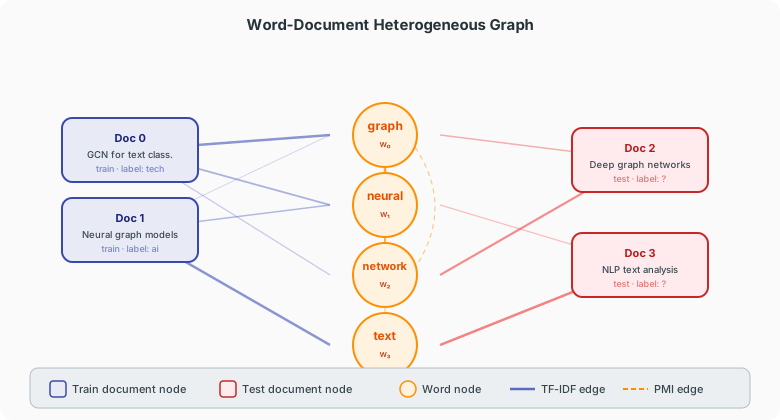
Node types
The graph contains two kinds of nodes:
| Node type | Count | Represents |
|---|---|---|
| Document nodes | train_size + test_size |
One node per document in the corpus |
| Word nodes | vocab_size |
One node per unique word in the vocabulary |
After preprocessing, the nodes are ordered as:
Edge types
| Edge | Direction | Weight | Meaning |
|---|---|---|---|
| Word ↔ Word | Undirected | Depends on the builder (PMI for tfidf()) |
Two words are related |
| Word ↔ Document | Undirected | TF-IDF score | A word appears in a document with that importance |
There are no document-document edges in the default graph (documents only connect through shared words).
Every builder writes the same TF-IDF word–document edges; they differ only in the word–word edges:
| Builder | Word–word weight |
|---|---|
Frequency.tfidf() |
PMI over a sliding window (below) |
Semantic.word2vec(), Semantic.bert(), Syntactic.linguistic_inquiry(), Syntactic.dependency_parsing() (RWF) |
Pair count divided by the largest pair count; positive PMI is only a gate |
Semantic.cosine_similarity() |
Cosine similarity of the two word vectors |
See Graph builders.
Word-word edges (PMI)
For Frequency.tfidf(), Pointwise Mutual Information is computed over a sliding window of size window_size:
Only positive PMI values produce an edge.
Word-document edges (TF-IDF)
TF-IDF measures how important a word is to a specific document relative to the whole corpus:
where tf(w, d) is the term frequency in document d, N is the number of documents, and df(w) is the number of documents containing w.
GCN information propagation
Why a graph?
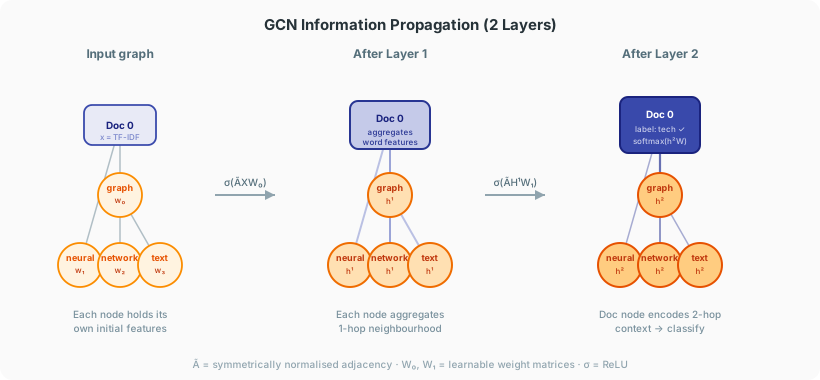
Bag-of-words models (TF-IDF vectors, naive Bayes) treat words independently. A graph captures co-occurrence context: if "neural" and "network" always appear together, the graph creates a strong edge between them and the model can leverage that signal.
GCNs propagate information along edges. A document node aggregates information from its word nodes; word nodes aggregate from both documents and co-occurring words. After two GCN layers, each document node contains a summary of:
- Its own word content (layer 1)
- Words that those words co-occur with (layer 2)
This is richer than a bag-of-words embedding with no structural signal.
Graph size
For a corpus with D documents and vocabulary size V:
| Quantity | Size |
|---|---|
| Nodes | D + V |
| Word-doc edges | up to D × V (sparse in practice) |
| Word-word edges | up to V × V; depends on the builder (and on window_size for PMI) |
For the R8 benchmark, the DCAI 2022 paper reports 7,674 documents and 7,688 words after filtering, so 15,362 nodes, and about 3.2 M edges in the TextGCN graph: word–word PMI edges dominate.
Inspecting the graph
After building adjacency with Frequency(...).tfidf(), the matrix is saved as a pickled scipy.sparse matrix. You can load and inspect it directly:
import pickle, scipy.sparse as sp

with open("data/R8.adjacency/ind.frequency.tfidf.R8.adj", "rb") as f:
    adj = pickle.load(f)

print(adj.shape)   # (nodes, nodes): training docs, then words, then test docs
print(adj.nnz)     # stored entries; GNN makes the graph symmetric when loading it
Or load the corpus and pass it through apply_refinement with return_metadata=True to get per-node type and degree information:
from text4gcn import Builder, RefinementConfig, apply_refinement
from text4gcn.models.utils import LoadData

predata = LoadData(path="data/", dataset="R8", builder=Builder.Tfidf).load_corpus()
_, info = apply_refinement(
    predata, RefinementConfig(), dataset_path="data/", dataset_name="R8", return_metadata=True
)

node = info["metadata"][0]   # one NodeMetadata per node
print(node.node_type, node.degree)
print(info["stats"])
# {'nodes_original': …, 'nodes_refined': …, 'nodes_removed': 0, ...}
An empty RefinementConfig() removes nothing; info["metadata"] is None when build_metadata=False.